Alternatives for Succulents
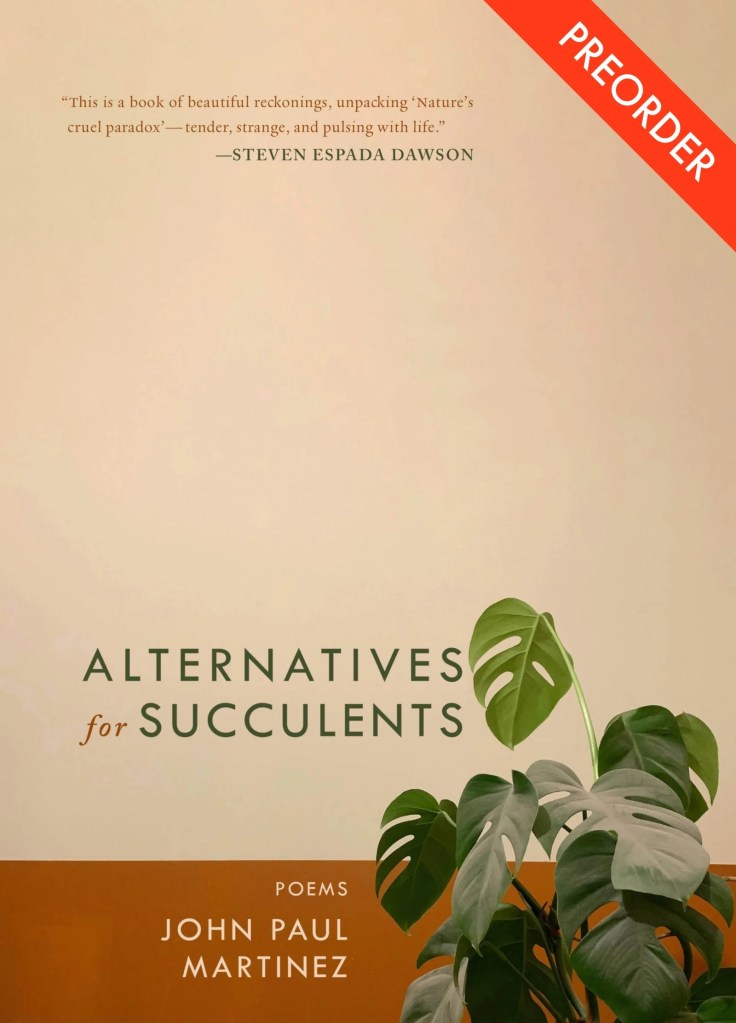
Alternatives for Succulents bends through the varied landscapes of longing, distance, sorrow, and self-discovery. Sprawling from the rural soil of Wisconsin to the unreachable pockets of space, these formally adventurous poems sift through what it means to want, to lose, and to remain tender. Like wind over an open field, they sprawl with breath. John Paul Martinez’s lush, aching debut is a book for the heart that breaks open and still blooms.
now available to Preorder at Bull City Press
“In Alternatives for Succulents, John Paul Martinez presses a palm to the ancient microphone and asks the oldest, most unshakable questions: Who am I? What am I doing here? The poems hover between gravity and flight—tethered to earth, yet always reaching for what flowers at the edge of knowing. Martinez weaves poems ripe with fruit, frozen hummingbirds, and splitting clouds, fracturing forms into pillars of longing, doubt, and quiet wonder. ‘I’m / still accumulating,’ one speaker confesses. ‘No one / expects to / become an / exhibit.’ This is a book of beautiful reckonings, unpacking ‘Nature’s cruel paradox’—tender, strange, and pulsing with life.”
— Steven Espada Dawson, author of Late to the Search Party
“Lush and luminous, John Paul Martinez’s chapbook Alternatives for Succulents is, like the poet, ‘in constant bloom.’ Find here, reader: ‘every lugubrious flower,’ canny forms, and deft movement down and across the page–these tender poems propagate longing and delight in equal measure.”
— Michelle Peñaloza, author of All The Words I Can Remember Are Poems
“John Paul Martinez’s Alternatives for succulents shows a world indifferent to the differentiations (of place, of perception) from which the self is constituted. In counterpoint: this roving ‘I,’ one ‘not as hungry as nature,’ yet ever-accumulating perceptions. Where does it move? ‘Into the deep field,’ ‘towards a new sun,’ within ‘the last safe pasture,’ along ‘this river that does / all of our work.’ Speaking, through it all, with clear voice: ‘I am many things / I am not yet / familiar with.’ ‘I would like to stave off the dark / by way of warmth.’ These poems observe the many lives (creaturely, human) lived ‘without the world’s notice.’ What do we find? We find ‘there are so few animals / who glow sincerely in the dark.’ We find elegies, aubades, nocturnes. It’s a record, but ‘nothing too scientific.’ It’s a book in which ‘a small sky twirls open / reveals a steady light.’”
— Bill Carty, author of We Sailed on the Lake
 John Paul Martinez